Why Younger Generations Are Turning Away from Manufacturing
And Why Rebuilding Domestic Industry Is Harder Than Most People Think
Manufacturing is often discussed as if its return is inevitable. Factories are reshoring. Automation is accelerating. Supply chains are being shortened. On paper, the momentum looks promising.
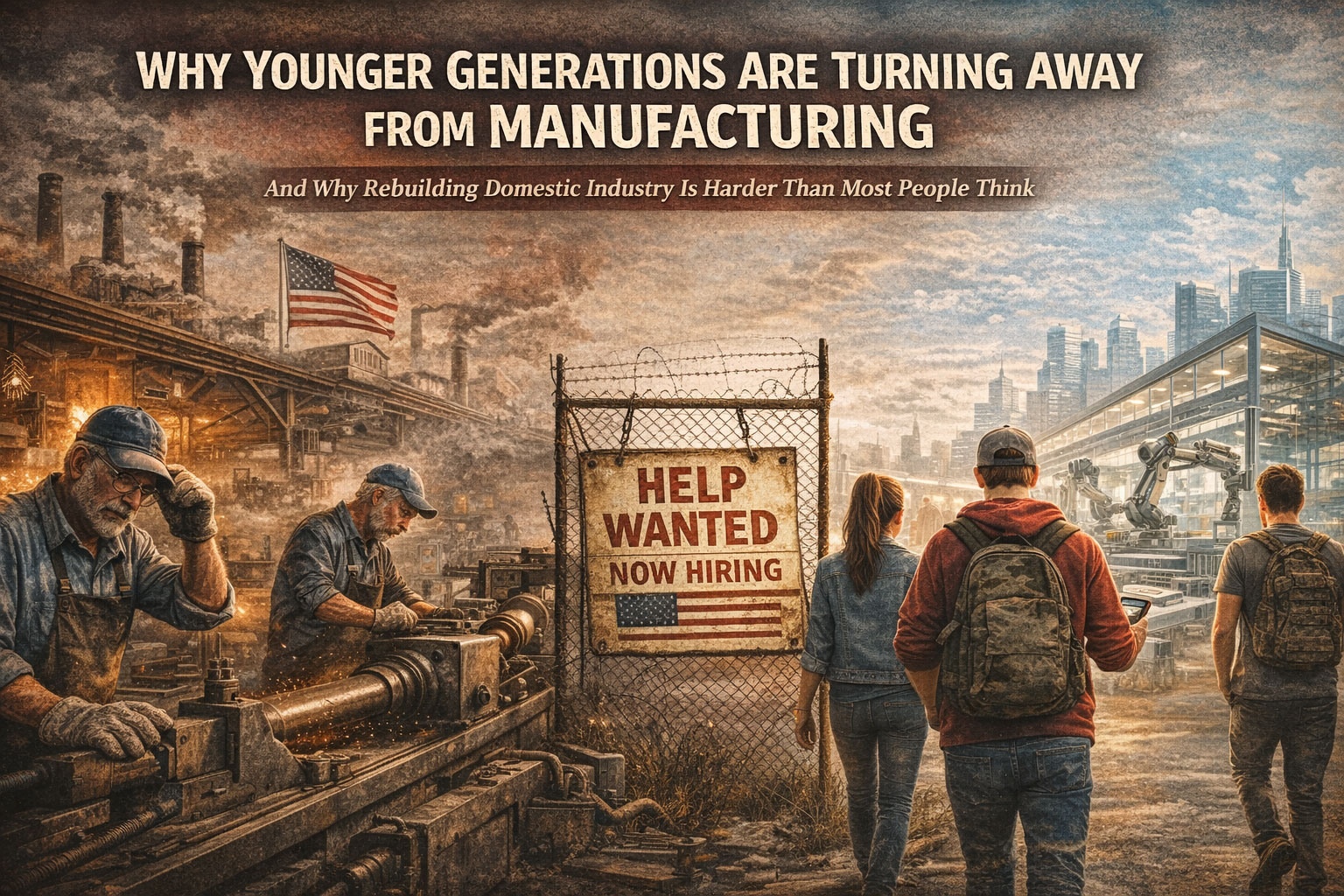
Yet beneath those investments sits a structural problem that technology alone cannot solve. Younger generations are not entering manufacturing at the rate required to sustain it. As experienced workers retire, the gap between available jobs and willing talent continues to widen.
For companies committed to domestic production, including USA Socks, this challenge is not theoretical. It is one of the defining constraints shaping what can be made in the United States, at what scale, and for how long.
Manufacturing’s Return Is Real, But the Workforce Has Not Followed
Over the past decade, U.S. manufacturing has entered a period of reinvestment. Global supply chain shocks, geopolitical risk, and rising overseas costs have pushed companies to reconsider domestic production. New equipment, robotics, and digital systems have modernized facilities that once struggled to compete.
What has not rebounded at the same pace is workforce participation.
Many manufacturers report strong demand for skilled roles alongside persistent hiring challenges. The issue is not a lack of jobs. It is a lack of alignment between what manufacturing offers and how younger workers perceive it.
This disconnect has been decades in the making.
How Manufacturing Earned Its Reputation With Younger Generations
For many younger workers, manufacturing is associated less with opportunity and more with cautionary stories. They grew up hearing about factories closing, jobs disappearing, and entire towns hollowing out. Those narratives left a lasting impression.
Manufacturing became framed as unstable, physically demanding, and vulnerable to forces beyond individual control. In contrast, careers tied to technology, finance, and digital services were presented as flexible, creative, and future-proof.
By the time automation and advanced manufacturing began transforming factory floors, those improvements were largely invisible to students making career decisions.
The reputation problem did not come from a single misconception. It formed through years of cultural messaging, educational emphasis, and lived experience in communities shaped by industrial decline.
The Education Gap That Reinforced the Divide
One of the most significant contributors to youth disinterest in manufacturing is the way career pathways have been presented in schools.
For decades, four-year college degrees were positioned as the primary route to success. Skilled trades and manufacturing careers were often treated as secondary options, discussed only when academic paths seemed out of reach.
As a result, many students never learned what modern manufacturing roles actually involve. They were not exposed to automation systems, digital controls, process engineering, or quality management. Manufacturing became something abstract rather than tangible.
By the time students encountered real job opportunities, many had already decided the industry was not for them.
Modern Manufacturing Is Not What Most Young People Picture
The reality of manufacturing today looks very different from the stereotypes that persist.
Modern facilities rely heavily on automation, robotics, data analysis, and precision systems. Many roles involve programming, troubleshooting, process optimization, and continuous improvement rather than repetitive manual labor.
Work environments are often climate-controlled, clean, and highly regulated for safety. Advancement paths can be clear, especially in operations that invest in training and cross-functional skill development.
Yet perception moves more slowly than reality. Without direct exposure, many young workers never see this side of the industry.
Why This Matters to USA Socks and Domestic Manufacturing
For USA Socks, the manufacturing workforce challenge directly shapes what is possible.
Producing socks domestically requires more than machinery. It requires experienced operators, maintenance technicians, quality specialists, and process thinkers who understand both textiles and modern production systems.
As older generations retire, replacing that knowledge becomes increasingly difficult. Training new workers takes time, patience, and investment. Without a steady pipeline of interested talent, even well-equipped facilities face limits on growth.
This reality helps explain why rebuilding American manufacturing is not as simple as turning machines back on. Skills, culture, and confidence must be rebuilt alongside infrastructure.
The Economic Reality Younger Workers Are Responding To
Younger generations are not rejecting manufacturing without reason. They are responding rationally to incentives and risk.
Many have seen family members experience layoffs tied to globalization or automation. Others worry about geographic immobility, physical wear, or long-term stability.
At the same time, manufacturing has struggled to clearly communicate how careers evolve over time. Without visible examples of progression, young workers often assume roles plateau early.
For domestic manufacturers, addressing this perception gap is as important as competitive wages.
Why Manufacturing Messaging Often Misses the Mark
When manufacturers attempt to attract younger workers, the messaging often focuses on technology alone. While automation and robotics matter, they are not enough.
Younger workers consistently value purpose, transparency, and the ability to see the impact of their work. They want to understand how what they do connects to something tangible.
This is where domestic manufacturing holds an advantage that is often underutilized. Products made locally carry a clearer story. Workers can see the outcome of their effort and its role in a broader system.
For USA Socks, that connection between craftsmanship, durability, and local accountability is central. But it must be communicated through experience, not slogans.
Rebuilding Interest Requires Early, Hands-On Exposure
Interest in manufacturing rarely begins at a job posting. It begins with exposure.
Programs that bring students into facilities, show how machines work, and allow them to interact with real production environments consistently change perceptions. Seeing technology in action replaces assumptions with understanding.
Partnerships with schools, trade programs, and community organizations play a critical role here. Manufacturing cannot wait until graduation to introduce itself.
The earlier young people see what modern manufacturing looks like, the more likely they are to consider it as a viable path.
Why Skills Matter More Than Credentials
One of the barriers to entry for younger workers has been rigid hiring requirements that emphasize credentials over capability.
Many manufacturing roles require aptitude, problem-solving, and mechanical understanding more than formal degrees. Skills-based hiring allows companies to identify potential rather than filter it out.
For domestic manufacturers, this approach widens the talent pool and accelerates learning. It also aligns with how younger generations expect to be evaluated.
When people feel judged on what they can do rather than where they went to school, engagement increases.
The Long View of Manufacturing Careers
Manufacturing careers are not static. They evolve as technology evolves.
Workers who begin in entry-level roles can move into programming, supervision, quality systems, or process engineering over time. These pathways exist, but they are often poorly articulated.
For companies like USA Socks, making these trajectories visible is essential. When young workers see a future rather than a job, retention improves and skills deepen.
Manufacturing becomes not just a place to work, but a place to build a career.
What the Future Workforce Will Require
The next generation of manufacturing workers will need a blend of technical and human skills.
Automation will handle repetition. Humans will handle judgment, creativity, and adaptability. Communication, critical thinking, and continuous learning will matter as much as machine operation.
This shift favors workers who are curious and engaged, qualities many young people already possess. The challenge is connecting those traits to manufacturing environments.
A Realistic Path Forward for Domestic Manufacturing
Rebuilding interest in manufacturing will not happen overnight. It requires coordinated effort across education, industry, and community.
It also requires honesty. Domestic manufacturing will never be the cheapest option. It must compete on quality, accountability, and long-term value.
For USA Socks, investing in American manufacturing means investing in people. Not just machines, but the knowledge and care that make products last.
When younger generations understand that manufacturing today is about skill, purpose, and impact, the industry has a chance to rebuild not just capacity, but confidence.
Younger generations are not avoiding manufacturing because they lack work ethic or ambition. They are responding to the story they have been told.
Changing that story requires more than technology. It requires visibility, education, and trust.
Domestic manufacturing depends on whether the next generation can see themselves in it. Companies that help make that connection will shape the future of American industry, one product and one career at a time.