How World War II Reshaped Clothing
When Clothing Became a Strategic Resource
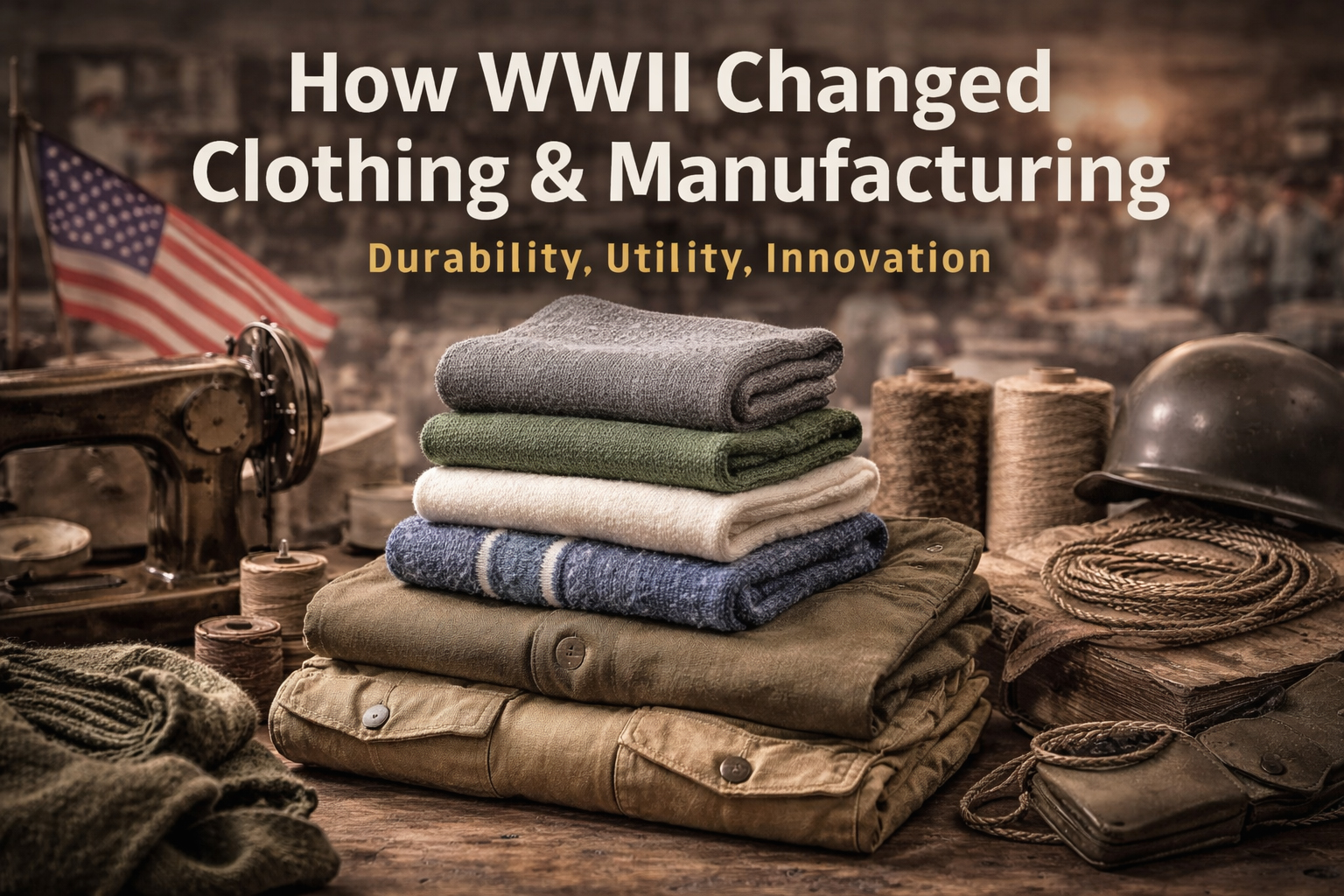
During World War II, clothing stopped being a matter of style and became a matter of strategy. Governments around the world were forced to confront a new reality, textiles were no longer abundant, and every fiber carried potential military value. The result was a fundamental shift in how clothing was designed, manufactured, and valued.
What emerged from this period was not simply a temporary adjustment, but a lasting transformation of industrial thinking. Durability replaced decoration. Utility replaced excess. Manufacturing discipline became a national priority. These principles reshaped civilian clothing during the war and continue to influence modern apparel production today.
Everyday garments such as socks, often overlooked in peacetime, became essential under wartime conditions. Long factory shifts, military training, and extended marches exposed the importance of proper foot protection, moisture management, and durability. Items once treated as disposable suddenly demanded reliability, reinforcing the idea that even the smallest garments played a role in national productivity.
For manufacturers committed to longevity and accountability, the wartime era offers an important lesson. Scarcity revealed what mattered most in clothing, and it permanently altered how quality was defined.
The Early War Years: Material Shortages and Industrial Reprioritization
Textiles Redirected to the War Effort
As global conflict escalated, materials traditionally used for civilian clothing were rapidly redirected toward military needs. Wool was reserved for uniforms and blankets. Silk was prioritized for parachutes, maps, and medical uses. Rubber, leather, and metal components were tightly controlled due to their importance in vehicles and equipment.
Civilian clothing production did not stop, but it was forced to operate under strict material limitations. Manufacturers had to rethink how garments were constructed, how much fabric was used, and how long products were expected to last. Hosiery production was directly affected, as fibers traditionally used for civilian socks were diverted to uniforms and military supplies, forcing manufacturers to rethink yarn blends, reinforcement, and efficiency.
Factories Transformed for Scale and Efficiency
In the United States, factories that once produced consumer apparel were retooled to supply uniforms, tents, webbing, and hosiery components for the armed forces. Production volume increased dramatically, but waste was minimized. Standardization became essential, not optional.
This era marked a turning point in American manufacturing. Precision, repeatability, and quality control became defining traits of successful factories, laying the groundwork for modern industrial standards.
Rationing and Design Constraints: Clothing Without Excess
Government Standards and Manufacturing Discipline
To preserve resources, governments introduced detailed manufacturing guidelines that governed civilian clothing production. These rules restricted fabric usage, eliminated unnecessary features, and standardized garment construction.
Design elements such as excessive pleating, oversized cuffs, decorative trim, and surplus pockets were removed. Clothing became simpler, more functional, and easier to manufacture at scale.
The Rise of Utility-Oriented Apparel
Utility clothing emphasized fit, durability, and repeatability. Garments were designed to withstand extended wear, laundering, and physical labor.
Socks and undergarments became critical performance items rather than decorative accessories. Extended wear requirements pushed manufacturers to focus on reinforcement at stress points, improved knitting consistency, and materials that could withstand repeated washing without rapid degradation.
This shift permanently altered public expectations of everyday clothing, including items that had previously been considered disposable.
Innovation Under Constraint: New Materials and Processes
Accelerated Development of Synthetic Fibers
Material shortages accelerated research into synthetic alternatives. Fibers such as rayon and early nylon variants were refined and adapted for practical use. These materials were not developed for fashion, but for performance and availability.
The emphasis on consistency and reliability pushed manufacturers to focus on fiber behavior under stress, moisture exposure, and repeated washing. These considerations remain central to quality apparel manufacturing today.
Advances in Knitting and Seam Construction
Wartime necessity also drove improvements in knitting techniques and seam efficiency. Manufacturers sought methods that reduced waste while improving garment strength. Seam placement, reinforcement zones, and yarn density became technical decisions rather than aesthetic ones.
Hosiery manufacturers in particular refined knitting density and seam placement to reduce material waste while maintaining comfort. These refinements contributed to early forms of reinforced heel and toe construction, a practice that remains foundational in quality sock manufacturing today.
Clothing for a Working Population
Women in Industrial Roles
As women entered factories and shipyards in unprecedented numbers, clothing had to accommodate physical labor. Garments were designed for movement, safety, and durability.
For workers standing or moving for entire shifts, durable socks became as important as footwear, reducing friction, fatigue, and injury in environments where replacements were limited.
The emphasis on comfort and performance during long shifts helped redefine what everyday clothing needed to accomplish.
Men’s Apparel and Military Influence
Military specifications influenced civilian men’s clothing as well. Simplified tailoring, durable fabrics, and standardized sizing became more common. The focus was on reliability and longevity rather than trend driven design.
Manufacturing at Scale: Lessons That Endured
Standardization and Quality Control
The war demonstrated that large scale manufacturing could coexist with strict quality standards. Uniformity did not mean inferiority. In fact, consistency became a measure of reliability.
Factories learned that disciplined processes, trained labor, and controlled inputs produced garments that performed predictably and lasted longer.
Durability as a Core Value
With limited access to replacements, clothing had to endure. This reality elevated durability from a desirable feature to a necessity. Products that failed prematurely were not merely inconvenient, they undermined productivity.
Small garments such as socks illustrated this principle clearly. When replacement was not guaranteed, manufacturers were forced to prioritize construction quality over cost reduction. This mindset laid the groundwork for treating durability as a measurable standard rather than a marketing claim.
The Postwar Shift: From Scarcity to Choice
Manufacturing Knowledge Applied to Civilian Markets
After the war, factories returned to civilian production with new expertise. Advances in material science, process control, and quality assurance were applied to consumer goods. Ready to wear apparel expanded rapidly, supported by the efficiencies developed during wartime.
Lasting Influence on Modern Apparel
Many principles born out of wartime necessity persist today. Minimalist design, functional construction, and respect for materials continue to influence apparel manufacturing. The modern focus on sustainability echoes the wartime emphasis on conservation and efficiency.
Why This History Still Matters
World War II revealed what clothing becomes when resources are limited and accountability is unavoidable. Excess disappears. Quality becomes measurable. Manufacturing decisions carry visible consequences.
For American manufacturers, this period established a legacy of discipline, resilience, and responsibility. It demonstrated that well made garments are not defined by decoration, but by how they perform over time.
That lesson remains relevant today. Clothing built with intention lasts longer, wastes less, and respects both the wearer and the system that produces it.
Utility as a Standard, Not a Compromise
The wartime transformation of clothing was not merely a historical anomaly. It was a recalibration of priorities. Durability, function, and manufacturing integrity proved essential under pressure.
Those values continue to guide manufacturers who believe clothing should earn its place through performance and longevity. When apparel is built to endure, it reflects a tradition shaped not by abundance, but by responsibility.