How Trade Policies Reshaped the Sock Industry
Tariffs, Globalization, and the Quiet Transformation of Manufacturing
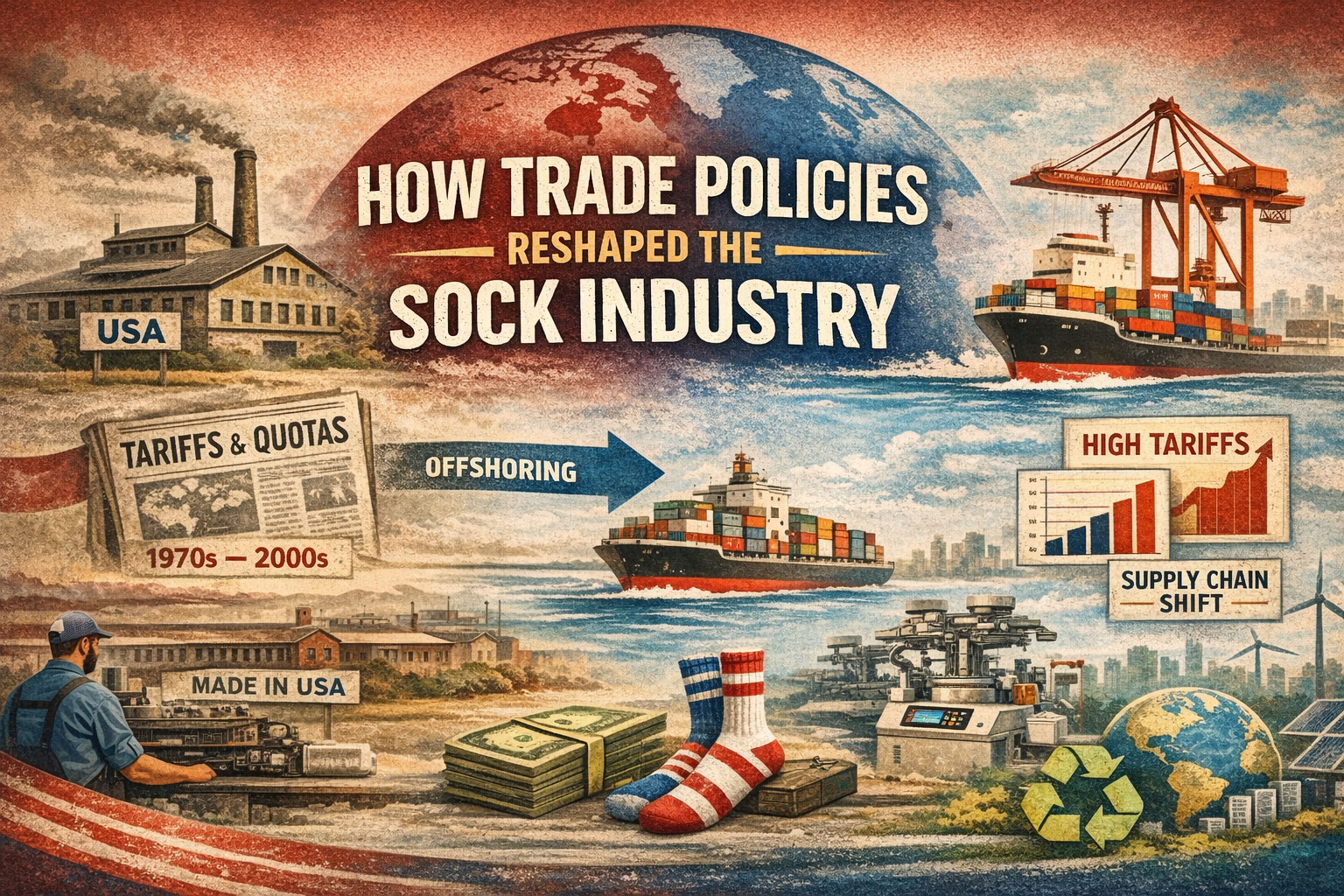
Socks are among the most overlooked products in modern manufacturing. They are inexpensive, ubiquitous, and rarely questioned by consumers. Yet few everyday items better illustrate how trade policies, globalization, and industrial economics shape what gets made, where it is made, and why entire domestic industries rise or disappear.
Over the past several decades, shifts in tariffs, trade agreements, labor dynamics, and production scale quietly transformed the sock industry. What was once a regionally concentrated, labor-intensive American manufacturing sector became one of the most globally distributed segments of apparel production. This transformation did not happen overnight, nor was it driven by a single political decision. It unfolded through a series of policy changes, economic incentives, and manufacturing realities that compounded over time.
For USA Socks, this history is not theoretical. It explains why American sock manufacturing operates the way it does today, why certain production decisions carry real consequences, and why rebuilding domestic capability is far more complex than simply choosing a different factory.
Understanding how trade policies reshaped the sock industry helps clarify why “Made in USA” is no longer the default, why domestic production today looks different than it did decades ago, and why modern American manufacturers must focus on durability, transparency, and long-term value rather than volume alone.
Key Takeaways
- Trade policies have reshaped the sock industry through cumulative, long-term effects rather than single events
- Globalization delivered efficiency but created concentration risk
- Domestic sock manufacturing today operates differently than in the past, focusing on value rather than volume
- Trade policy, technology, and sustainability will continue to shape the industry’s future
- Informed choices by brands and consumers alike play a role in determining how socks are made moving forward
A Timeline of Trade Policy and Sock Manufacturing
Pre-Globalization, Regional Manufacturing and Domestic Scale
For much of the twentieth century, sock manufacturing in the United States was regionally concentrated, particularly in the Southeast. Towns in Alabama, North Carolina, and Tennessee developed specialized labor pools, supplier ecosystems, and production knowledge that supported domestic sock mills at scale. The industry relied on proximity to cotton supply, established knitting expertise, and vertically integrated operations.
During this period, tariffs existed but were relatively stable and predictable. Domestic production competed primarily on efficiency, craftsmanship, and regional specialization rather than global wage arbitrage.
Trade Liberalization and the Acceleration of Offshoring
The acceleration of globalization in the 1990s fundamentally altered the economics of sock manufacturing. Trade agreements such as NAFTA and the expansion of global trade frameworks reduced barriers to importing finished goods. China’s accession to the World Trade Organization in 2001 further accelerated this shift.
Lower labor costs, expanding industrial capacity, and aggressive export strategies made overseas production increasingly attractive. Sock manufacturing, which is labor intensive but technologically scalable, moved rapidly offshore.
By the early 2000s, import volumes surged. U.S. sock producers struggled to compete with pricing driven by global wage differentials rather than operational efficiency.
Safeguards, Quotas, and Temporary Relief
In response to the rapid influx of low-cost imports, the U.S. government enacted safeguard measures and quotas under Section 421 of the Trade Act of 1974. These policies aimed to slow import growth and provide domestic mills with temporary relief.
For a brief period, these measures stabilized portions of the domestic industry. However, they did not reverse the structural shift already underway. When quotas expired in 2008, import volumes rebounded quickly, and many remaining U.S. mills closed or consolidated.
This period marked a turning point. Trade policy could delay decline, but it could not restore lost scale or labor infrastructure without broader industrial investment.
Anti-Dumping Duties and Selective Enforcement
Following the expiration of quotas, anti-dumping duties were applied to certain categories of imported socks, particularly athletic and performance styles. These duties targeted unfair pricing practices but were applied selectively and inconsistently across categories.
While helpful to specific producers, these measures did not fundamentally alter sourcing behavior. Global supply chains had already matured, and retailers had adapted to offshore production timelines and pricing structures.
By this stage, the U.S. sock industry had transitioned from mass-market production to niche, premium, and specialized segments.
Modern Tariff Escalation and Renewed Volatility
The introduction of Section 301 tariffs in the late 2010s reintroduced uncertainty into global sock sourcing. Tariffs applied broadly across textile categories increased landed costs and disrupted long-standing sourcing assumptions.
Unlike earlier periods, these policies affected not only China but also alternative manufacturing regions as trade relationships evolved. Diversification strategies that once offered stability began to carry their own risks.
For the sock industry, the result was not a return to domestic mass production, but a reassessment of cost structures, quality tiers, and long-term resilience.
Globalization and the Industrial Reality of Sock Manufacturing
Why Socks Moved Offshore
Sock production combines high labor input with specialized machinery. Overseas manufacturers developed enormous scale advantages by clustering production, investing in automation, and training large workforces dedicated solely to knitwear.
These conditions allowed offshore producers to spread capital costs across massive output, maintain consistent quality at volume, and respond quickly to large retail orders.
By contrast, domestic producers faced shrinking labor pools, aging equipment, and rising compliance costs.
WTO Rules and Supply Chain Concentration
Global trade frameworks encouraged specialization by region. Over time, this led to supply chain concentration, particularly in Asia. While efficient, this concentration introduced systemic risk, which was exposed during events such as the COVID-19 pandemic, shipping disruptions, and sudden tariff changes.
The sock industry became a case study in the benefits and vulnerabilities of globalized manufacturing.
The Challenge and Opportunity of Made in USA Socks
Structural Barriers to Domestic Production
Rebuilding domestic sock manufacturing at scale faces significant challenges. These include limited skilled labor availability, high capital investment requirements for modern knitting equipment, regulatory and compliance costs that materially impact pricing, and continued reliance on imported raw materials and components.
Even with tariffs, domestic production often competes in different market segments than mass-produced imports.
Where Domestic Manufacturing Makes Sense
Despite these challenges, domestic sock manufacturing has found renewed relevance in premium and performance products, smaller production runs, transparent supply chains, and ethical and environmentally conscious markets.
Rather than competing on lowest price, domestic producers compete on accountability, durability, and long-term value.
For USA Socks, producing domestically is not a branding shortcut. It is a manufacturing decision shaped by decades of trade policy, labor shifts, and infrastructure changes.
Domestic sock production today requires working within real constraints. Limited skilled labor, higher capital investment, stricter compliance standards, and smaller production runs all influence how American socks are designed, priced, and produced. The result is not mass-market volume, but accountability, consistency, and durability.
This reality explains why American-made socks occupy a different place in the market, and why value must be measured over time rather than at checkout.
How Trade Policy Influences Price, Quality, and Choice
Tariffs do not operate in isolation. They affect material selection, supplier relationships, product durability, and retail pricing strategies.
Brands often face a strategic decision. They can reduce quality to maintain price, or elevate product value and reposition. Many have chosen the latter, recognizing that long-term trust depends on consistency rather than short-term cost suppression.
Diversification and the New Sourcing Model
In response to trade volatility, many brands have adopted multi-country sourcing strategies. This approach reduces dependence on any single region but increases operational complexity.
Modern sourcing increasingly prioritizes geographic diversification, traceability, shorter lead times, and risk management over absolute lowest cost.
Trade volatility has reinforced an important principle at USA Socks. Manufacturing resilience matters more than chasing the lowest possible cost.
Rather than relying on complex global sourcing strategies that shift with every policy change, USA Socks prioritizes domestic production wherever possible. This approach shortens supply chains, increases transparency, and reduces exposure to sudden tariff swings that can compromise quality or consistency.
In a category often treated as disposable, this model supports long-term reliability and trust.
Technology, Sustainability, and the Future of Socks
Automation and Manufacturing Innovation
Advances in knitting technology and automation have reduced labor dependency and improved efficiency. These innovations make smaller-scale domestic production more viable, particularly for specialized products.
Environmental Considerations
Trade policy intersects with sustainability in meaningful ways. Shipping distances, material sourcing, and production methods all affect environmental impact. Domestic and near-shore production models offer opportunities to reduce emissions and improve oversight.
Communities, Workers, and Industrial Legacy
The decline of domestic sock manufacturing affected more than factories. It reshaped communities. Towns once built around textile production experienced economic contraction, job loss, and population decline.
Recent investments in limited domestic manufacturing have demonstrated that industrial revival, while challenging, can restore both employment and local identity when aligned with modern market realities.
USA Socks exists as a response to the long arc of trade and manufacturing decisions that reshaped the sock industry. Not as a rejection of globalization, but as an acknowledgment of its limits.
By focusing on American manufacturing, USA Socks reflects a modern interpretation of domestic production. One that values craftsmanship, ethical labor practices, and durability over speed and volume. It is not a return to the past, but an adaptation to the realities created by decades of trade policy and industrial change.